
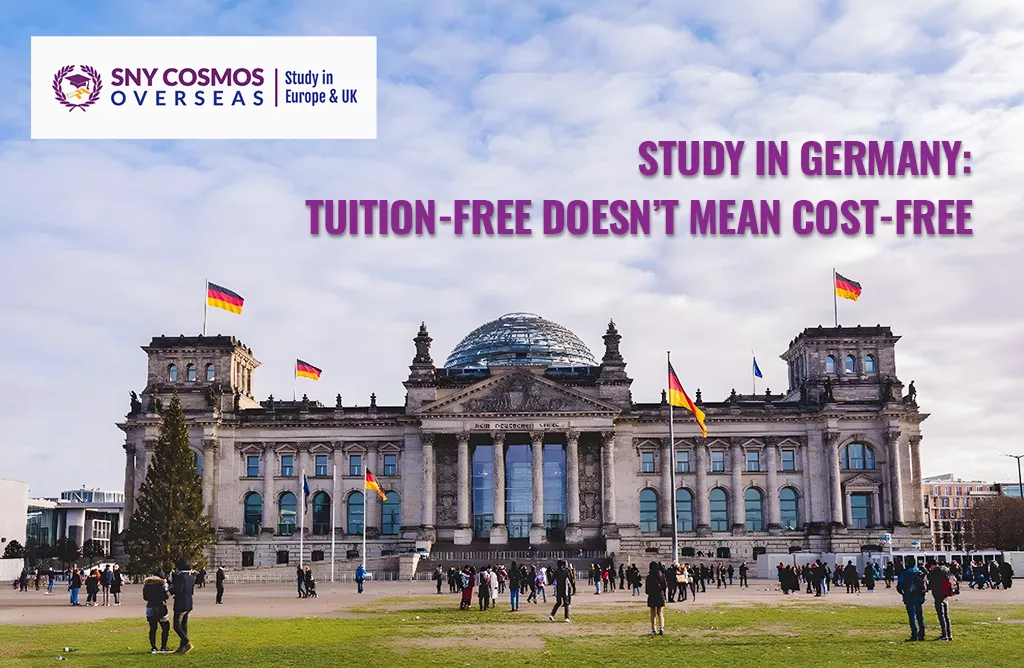
Germany has gained a reputation for providing free education in its state universities, which attracts thousands of foreign students every year, especially from India. The popularity of the “Study in Germany” program has increased manifold in the last few years.
But there are some facts that need to be kept in mind by the students before opting for the course.
Tuition-free doesn’t mean free.
And it certainly doesn’t mean that admission is free either.
Germany is one of the top destinations for value-for-money education for foreign students, but it is for those students who are academically strong, financially sound, and aware of the competition.
1. What “Tuition-Free” Actually Means
Most public universities in Germany:
- Do not charge tuition fees
- Require a semester contribution of €250–€600
- Maintain very high academic standards
However:
Private universities charge €9,000–€20,000 per year
Some states, like Baden-Württemberg, charge tuition for non-EU students
Living expenses remain mandatory
So, though the title is ‘free education,’ proper planning is necessary.

2. The Real Cost: Living Expenses
To apply for a German student visa, it is necessary for students to show proof of funds, for which they need to maintain a blocked account (Sperrkonto).
As of 2026, students need to show up:
€11,208 per year
€934 per month
This is for living expenses, and tuition fees are separate.
Average monthly expenses:
- Accommodation: €400–€800
- Health insurance: €50–€120
- Food: €200–€350
- Utilities and Internet: €50–€100
- Miscellaneous: €100–€200
Students may need to spend more, like €1,300 or more per month, if they are staying in cities like Munich or Frankfurt.
Students also need to consider other expenses, such as:
- Visa fees
- APS certification (mandatory for Indian students)
- Flight tickets
- Security deposits (2–3 months’ rent)
- Initial room setup costs
It is recommended for families to prepare funds for the blocked account and also an additional sum of €5,000–€8,000.
3. The Part-Time Job Myth
Students in Germany have the opportunity to work:
- 120 full days or
- 240 half days per year
The average wage for part-time jobs ranges between €8 to €12 hourly.
However, the part-time job market is competitive.
Knowledge of the German language increases the chances.
Academic demands are high.
Part-time jobs must be regarded as an additional income, rather than a survival strategy.
Students who rely on their part-time jobs for survival usually fail in their academic studies.

4. Free Education is Merit-Driven
Germany’s academic institutions, particularly the public ones, are extremely competitive.
Earlier, students who had around 75% could apply.
Today, for courses such as Engineering, AI, Data Science, and Computer Science, 85% or above is the preference.
Not that the academic institutions have made this requirement, but the competition for the limited number of available spots in the public academic institutions is increasing due to:
A rise in the number of international students applying.
Limited spots are available in the public academic institutions.
Academic standards must be upheld.
In some courses, even students with 90%+ have to compete.
5. Possible Exceptions
Students who score below 85% can still get admitted if:
- Their core technical subjects are strong
- They are German language certified (B2/C1 level)
- The course is not too competitive
- The location of the university is in a smaller city
- They have internships/work experience
- Their Statement of Purpose is well-aligned
Germany has a holistic evaluation system, but it is essential for students who score below 80% to be realistic about the competition.
6. Strategic Advice: Public + Private Universities
If your score is below 85%, it is a risk to apply only to public universities.
A balanced strategy would be to apply to public universities, along with some private universities.
Private universities can provide:
- Flexible admission requirements
- Industry-oriented courses
- Small class sizes
- Structured academic support
Private universities require tuition fees, but they provide a viable option for students who cannot meet the requirements of public universities.
7. Who Should Choose Germany?
Germany is a good option for students who:
- Have a strong academic record
- Can financially support themselves for 12-18 months
- Are independent learners
- Are you willing to learn German?
- Want a future in engineering, automotive, IT, renewable energy, and manufacturing
- Germany is not a shortcut.
- Germany has a discipline-driven education system.

8. Career Prospects After Graduation
Germany has strong career prospects in fields like:
- Mechanical Engineering
- Automotive
- Electrical Engineering
- AI & Data Science
- Renewable Energy
- Logistics & Manufacturing
Students are offered an 18-month visa for searching for jobs, but the key factors for getting jobs are:
- Skills
- Internships
- German language skills
- Networking
Employers prefer skills and experience over the type of university, whether public or private (as long as the university is recognized).
Conclusion
Germany’s reputation for tuition-free education is strong, but the reality is quite different. Studying in Germany is quite cost-effective, but the key is to be strong enough, financially sound, and realistic about the whole scenario.
Students who want to study in European countries must consult abroad education consultants or search for study abroad consultants near me to understand the admission criteria for studying in European countries.
Students must consult education consultants like SNY Cosmos Overseas to develop strategies for studying in European countries, like Study in the Netherlands instead of Study in Germany, if the competition for admission in German public universities is too fierce.
Germany does offer low-tuition or tuition-free education, but the key is to be well-prepared, meritorious, and realistic.
FAQ’s
1. Is education free when you study in Germany?
The answer is no; although no tuition fees are paid in most German universities, other costs are incurred by the students.
2. What percentage is required to study in Germany?
The answer is that no particular percentage is required; however, it is preferred that students should have 85 percent or higher to study in German universities, especially in the field of engineering or technology.
3. Can students work part-time while studying in Germany?
The answer is yes; students can work 120 full days or 240 half days in a year while studying in Germany; however, it is not preferred that students should depend completely on their part-time job for their expenses.
4. Do I need education consultants to apply to German universities?
The answer is no; however, students often seek the help of abroad education consultants or study abroad consultants near me to apply to German universities.
5. Which consultancy helps students study in Germany?
The answer is that students often seek the help of experienced consultants such as SNY Cosmos Overseas to study in Germany; they also offer the option to study in the Netherlands or other European countries.